EndNote vs Paperpile
February 23, 2026 | Author: Laura Candler
12

Intelligent reference manager that lets you store and manage an unlimited set of references, perform full-text searches, insert properly formatted references and create bibliographies as you write your research. The program uses a system of tags and rules to automatically organize references throughout a project, and AI to identify key findings. You can ask the AI additional questions and receive answers from the text to delve deeper into the topic. It also can translate whole PDFs. EndNote also includes collaborative tools that allow to share entire libraries or subsets of references, set access rights, view activity logs to stay informed about progress.
8

Simple and convenient web app for managing bibliographic references, integrated with Google Apps (allows you to log in with your Google account, sync PDFs with Google Drive, cite articles in Google Docs, collect references using a Chrome extension). Paperpile lets you organize your articles with folders, tags, and stars, search the library in real time or quickly find articles online. It automatically corrects incomplete references and removes duplicates. You can import data directly from Google Scholar, PubMed, ArXiv and thousands of supported publisher websites. Apps for iOS and Android are available, as well as a Word plugin.
EndNote vs Paperpile in our news:
2021. Paperpile comes to iOS and Android
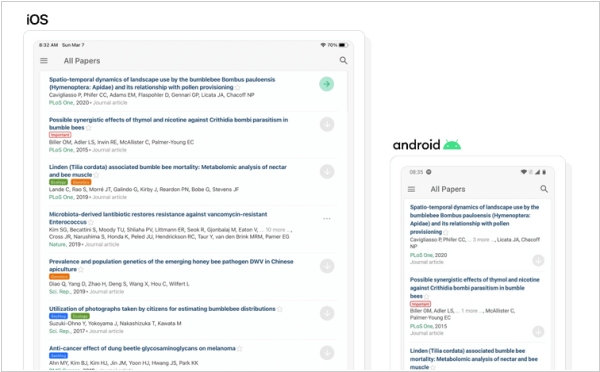
Paperpile has announced the availability of its Academic Paper Management software for iOS and Android, enabling users to sync their web library seamlessly across all their mobile devices. Any new references saved on the web app on the computer will be instantly available on the phone and tablet and vice versa. The software allows users to select which PDFs to download to their device instead of automatically downloading all 10 GB worth of PDFs. Users can also choose to download all PDFs in a specific folder or with a specific label. The "Add new" tab features a search bar with an up-to-date database of over 150 million articles, including biomedical papers from PubMed, preprints from arXiv and articles with DOIs from CrossRef. With the Chrome extension, users can save references and PDFs with a single click while browsing.