Mendeley vs Zotero
February 17, 2026 | Author: Laura Candler
17

Free, universal reference manager for managing and sharing research papers, as well as creating bibliographies for research articles. Mendeley allows to search over 100 million articles from multiple publishers, quickly add PDFs to your library, organize them with collections and tags, then read and annotate them. You can work with a single database across the desktop app, web version and Word plugin. It provides 2 GB of free storage. The program features an AI assistant that thoroughly understands your library and quickly finds what you need, identifying patterns, relationships, and missing links in your references. Mendeley's AI interprets the logic behind your queries, extracting context-rich information from your documents.
15

Free, open-source software for managing bibliographic data and research-related materials. Zotero helps to collect, organize, annotate, cite and share research results. The built-in assistant automatically identifies research as you browse the web and creates citations and bibliographies for any text editor, as well as directly in Word, LibreOffice, and Google Docs. You can sort items into collections and tag them with keywords. You can also create saved searches that automatically populate with relevant materials as you work. The program runs on Mac, Windows, Linux, Android, and iOS.
Mendeley vs Zotero in our news:
2018. Zotero adds new PDF features, faster citing in large documents

Scientific paper management software Zotero brings several notable enhancements to PDF-related workflows, as well as a new citing mode that can significantly accelerate the use of the word processor plugin in sizable documents, along with various other tweaks and bug fixes. In particular, Zotero 5.0.36 features a brand-new PDF recognizer that employs a web service designed by Zotero, which doesn't depend on Google Scholar and enables recognition of large quantities of PDFs without any rate restrictions. Upon receiving the first several pages of a PDF, the Zotero client sends them to the web service, which utilizes various extraction algorithms and metadata obtained from CrossRef, coupled with DOI and ISBN searches from the client, to construct a parent item for the PDF. The Zotero lookup service doesn't mandate a Zotero account and doesn't track any data about searches' outcomes or contents. Moreover, when metadata is retrieved for a PDF or PDFs are added to existing Zotero items, Zotero automatically renames the file based on the parent metadata, regardless of whether the files are stored or linked. Future Zotero releases will furnish more options to customize the naming format.
2015. Mendeley Data allows to get DOI online
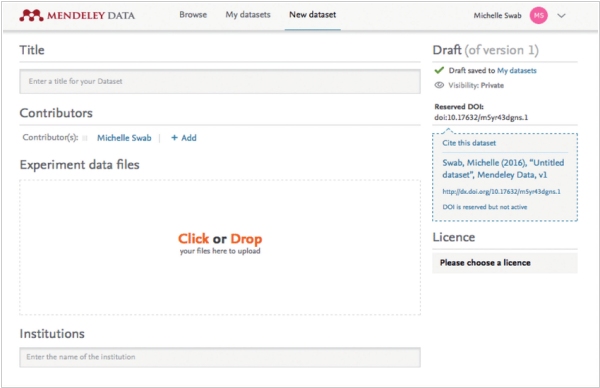
Mendeley now allows researchers to upload their raw research data and assign it a unique identifier (a versioned DOI), making the research citable. For partner journal websites (currently ScienceDirect, Cellpress) the article links to the research dataset on Mendeley Data, allowing readers to quickly navigate from the research article to the raw data. The dataset also links back to the article. Researchers can also "confidentially" share their unpublished data with colleagues and provide access to multiple versions of the data related to a single research project, creating a continually updated dataset. Mendeley Data is a free service and the datasets are licensed under several open licenses. Furthermore, all web application functionality will be accessible through a public API, allowing other applications to build on and interact with the research data repository.