BookONO E-book Manager vs Calibre
November 26, 2025 | Author: Maria Lin
20

BookONO is a free e-book manager and reader (PDFs and EPubs fully supported) designed as a compliment to Calibre. It is written in C++ using the Qt5 Toolkit. It is different from Calibre in that it makes a few different design decisions than Calibre, for instance it does not attempt to put all your books in its own library or change their names. Where Calibre attempts to take complete control over your books, BookONO gives you control over your books. BookONO further attempts to take a different direction in terms of its UI, providing a more user-friendly, aesthetically-pleasing experience than Calibre.
62

Calibre is a free, open-source program (written in Python) for managing e-book libraries on Windows, Mac and Linux. It offers the most rich set of features, divided into the following main categories: library management, e-book conversion, synchronization with e-readers, downloading news from the internet and converting them to e-book formats, e-book viewer-reader, e-book editor and a content server for web access to your book collection. The program reorganizes book files into own structure. There are numerous plugins developed for the program by the community. However, many find the interface cluttered and unwieldy.

See also:
Top 10 eBook Organizers
Top 10 eBook Organizers
BookONO E-book Manager vs Calibre in our news:
2015. BookONO adds a PDF and EPub reader
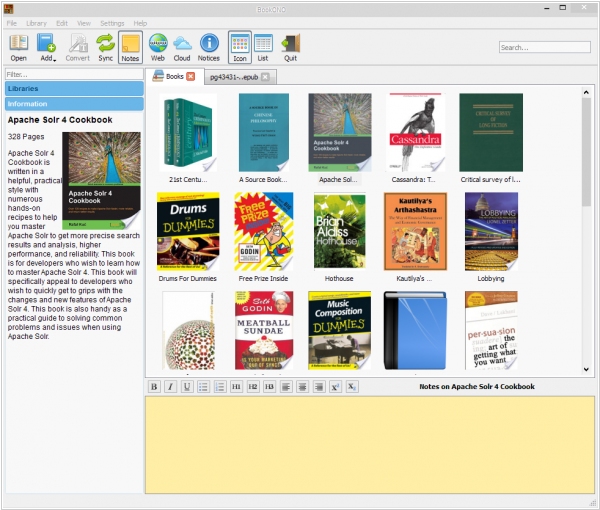
Etopian has released a new version of its BookONO E-book Manager with PDF reader and EPub reader. It also features upgrade to Qt5, author filters, notes and toolbar for notes, button to the notes toolbar to add current date and time, cloud syncing between all three platforms, categories and tags. BookONO does not attempt to reinvent or rewrite Calibre’s programming, instead calling Calibre to do many of the tasks that Calibre already does… We hope in the future to rewrite slow aspects of Calibre, naively in C++; but leave the rest of the job to Calibre which Kovind Goyal has obviously put a lot of thought into and we’re grateful for that.